Frequently Asked Questions
The most-asked questions about plants & fungi.
What is the fundamental difference between plants and fungi?
Plants are photosynthetic organisms that synthesize their own food from sunlight, while fungi are heterotrophs that absorb nutrients by decomposing organic matter or forming symbiotic partnerships. They sit in entirely separate biological kingdoms with different cell-wall chemistry and evolutionary lineages.
What are the major groups within the plant kingdom?
The plant kingdom is commonly split into bryophytes (mosses and liverworts), pteridophytes (ferns and horsetails), gymnosperms (conifers and ginkgo), and angiosperms (flowering plants). Angiosperms dominate in diversity, representing roughly 300,000 of the ~390,000 described plant species.
What is a mushroom, and how does it differ from the rest of the fungus?
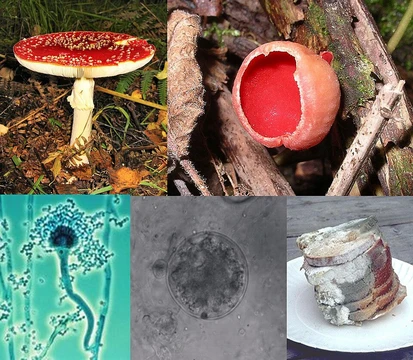
A mushroom is simply the fruiting body — the short-lived reproductive structure a fungus pushes above ground to scatter spores. The bulk of the organism lives hidden underground as a vast network of thread-like hyphae called the mycelium, which can cover acres.
How do plants and fungi interact in natural ecosystems?
The best-known partnership is the mycorrhizal association, in which fungal hyphae enwrap or penetrate plant roots and trade absorbed minerals and water for photosynthetic sugars. This mutualism is estimated to involve around 90 % of land-plant species and is critical to forest productivity.
What is the 'wood wide web'?
It is a popular nickname for the underground fungal networks that link the root systems of multiple trees, enabling them to share carbon, nutrients, and chemical warning signals. The term gained wide attention through Suzanne Simard's research and Peter Wohlleben's 2015 book *The Hidden Life of Trees*.
How many species of plants and fungi are known to science?
Taxonomists have described roughly 390,000 plant species and between 150,000 and 200,000 fungal species so far, though many mycologists suspect the true fungal count could exceed two million. New species in both groups are still being catalogued, particularly in tropical forests and deep-sea environments.
What are the main phyla of the fungal kingdom?
Fungi are generally sorted into four major phyla: Ascomycota (sac fungi such as yeasts and truffles), Basidiomycota (club fungi including most familiar mushrooms), Zygomycota (bread molds), and Chytridiomycota (mostly aquatic chytrids). A fifth group, Glomeromycota, is sometimes recognized for its root-colonizing species.
Where should a complete beginner start learning about plants and fungi?
A solid first step is grasping the contrast between photosynthesis and decomposition, then surveying the major plant groups and fungal phyla at a high level. From there, a local nature walk, a beginner mycology field guide, or volunteering at a community garden can turn abstract taxonomy into hands-on recognition.
What are some of the most ecologically notable or 'famous' examples?
On the plant side, the giant sequoia and the Pando aspen grove (a single clone of roughly 40,000 stems in Utah) are often cited for their extraordinary scale. In the fungal world, the Armillaria ostoyae colony in Oregon's Malheur National Forest, spanning about 2,385 acres, is the largest known organism on Earth by area.
Why do fungi capture public imagination more than plants do?
Fungi occupy a liminal identity — neither animal nor plant — and include both life-saving agents like penicillin and deadly pathogens like the chestnut blight, which gives them an almost alien duality. Add the visual drama of mushrooms appearing overnight after rain, and the result is a mystique that steady greenery rarely commands.